
Two Teepees In A Field
Maverick: Chapter 17

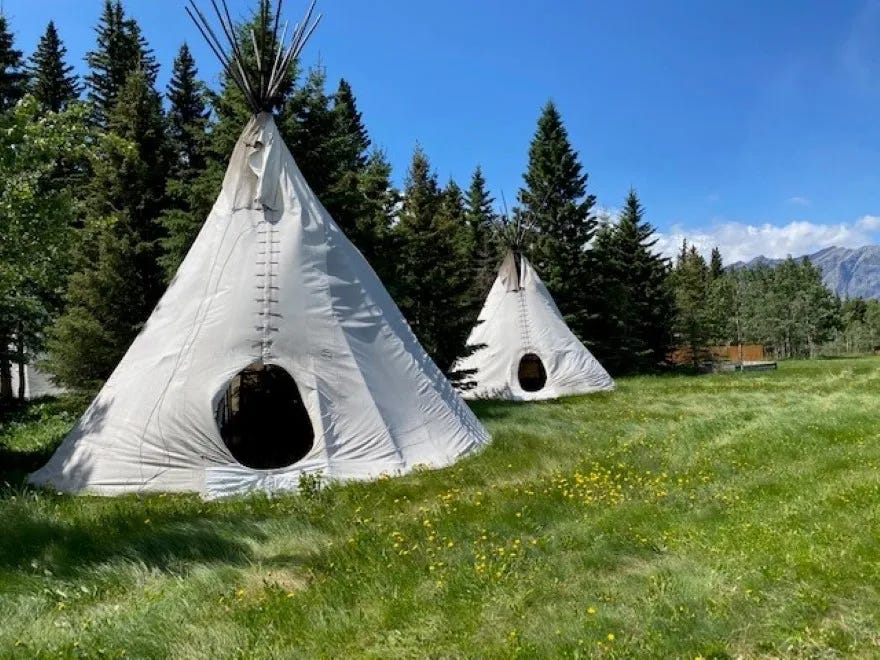
July 14, 1975, two white, 23-foot-high canvas teepees, smoke flaps flaring, stood at the edge of a meadow surrounded by an aspen-spruce forest. A quarter mile west of Yamnuska Centre’s Bowfort Lodge. Mount Baldy loomed above, backlit by the mid-morning sun. Cia Gadd, a thirty-something, ex-Coloradan, looked hippyish in a long, floral skirt, beige fleece jacket, and scuffed hiking boots. She and mountaineer husband, Ben, had taken Pooh House kids camping. With the countenance of a grinning Mona Lisa, not much rattled Cia. She held court at the fire circle with nine girls, aged 14 to 17, in shorts, jeans, new hiking boots, and a rainbow of t-shirts. They sat on log stumps, braiding each other’s hair and giggling about boys.
So much giggling!
I huffed a breath. In a beige, long-sleeve tee, navy rugby shorts, camp shoes (pre-waffle Nike flats), and an almost-new Harris Tweed Trilby, I sat cross-legged beside the second teepee, gnawing my knuckle. I wanted the girls to talk about challenge, personal mastery, and the environment, not snigger about boys.
Earlier that morning, we had set out to hike to Baldy’s summit. I’d wanted to give the girls an overview of our site, the valley, and surrounding peaks. But a fast-moving storm turned the muddy trail into a Slip ‘N Slide.
“Rain gear,” I said. “Everyone. Hike on the edge. Footing’s better.”
As the girls struggled into rain jackets, I said, “Just a short downpour. We can shelter at the fire lookout.”
Cia agreed. But the girls wouldn’t budge.
“This sucks,” whined Marie, a 14-year-old, sun-bleached California surfer girl, whose father taught at the University of Calgary.
“I didn’t come here to get soaked,” said a redhead in muddied bell-bottoms.
“Yeah!” echoed the jejune chorus.
Heart hammering, nails knifing into my palms, we bushwhacked them through a mile of tight-packed spruce to a gentle trail that led down to Hector. I prayed no one saw us as we walked the paved road back to our teepees. Sun broke through the clouds as we reached the meadow. In moments, bushes bloomed with steaming jeans and multicoloured jackets.
Now, the girls sat at the fire circle, cackling like apprentice witches. I ground my teeth. I want — I fucking need! — this to work. I struggled to my feet, then stumbled out of the meadow onto the west end trail. Blood pounded in my ears. A black fist pressed against my forehead. Earthways had only just begun — and I felt like packing it in.
In the spring, after I had shared my vision with Ken, doubts about my ability to realize it dogged me. But when I ran the idea by Gary Luthy, he said, “Let’s talk logistics.” I approached Cia. She was keen, but only available for first period. Gary promised to provide an experienced counsellor for second period. So, I scheduled the 9-day July pilot and a 21-day August experiment.
During May and June, I scribbled press releases, sent fliers and made phone calls to Phys Ed teachers and Y branches. A radio interview recruited three kids. Terrified I wouldn’t have enough to run a program, I hardly slept. But when I persuaded Gary to let me send fliers to former PIT campers, numbers rose. With Ken and Gary’s support, my vision seemed doable.
I told Kim and Chris about my plans. Kim’s eyebrows lifted. Chris shook his head. “Two teepees in a field, with meals in the Lodge, is no wilderness camp.” I had yet to see any sign of Camp ChrisKim. So, fuck'em. It’s a start.
Some start, I muttered as I shambled along the west trail. After 15 minutes, birdsong and the aroma of sweet aspen sap calmed me. My shoulders relaxed. The fist eased off.
It’s only the first day!
I imagined what my mentors might advise:
Dimock: “Tighten your corrals.”
Steve: “Start where the learners are, not where you are.”
Ken: “Make appropriate behavioural adjustments at critical Action Sites.”
Where aspen and spruce gave way to lodgepole pine, I cupped sweet water from a trickling trailside spring. Sunbeams splintered through pine branches. Ken’s Ronin motto came to mind: Expect nothing; be ready for anything.
I smiled, then trotted back to Camp.
This is my Can-Do challenge. It’s not supposed to be easy!
Cia and I called a “Why we’re here” meeting with the girls. I had forgotten to do so when they’d arrived. I explained ACC and Action Studies to puzzled faces. Then Cia persuaded the group to do a blindfold walk.
In the woods near the spring, girls pulled on black blindfolds, then grasped a rope stretched between Cia and me. We eased into the ecotone where aspen and spruce gave way to pines. Girls traced branches, leaves, and needles with their fingertips. They compared bark patterns by feeling two species at the same time. Scooped up duff, inhaled the sweet, earthy odours, and noted differences between conifer and deciduous areas. We led them from forest shade into cheek-warming sunlight and across a stony meadow. As we trudged up the drumlin’s long tail, the girls fingered shrinking aspens stunted by prevailing Westerlies. When we emerged onto a grassy promontory above the natural concert bowl, they grouped together, sensing, it seemed, they were somewhere high. Then they removed blindfolds; mouths dropped, pupils dilated, smiles erupted.
“Oh, wow! Rad! This is sooo cool! Thanks!”
I let my body relax and high-fived Cia.
In her book The Sense of Wonder, Rachel Carson wrote the greatest gift we can give a child is “a sense of wonder so indestructible that it would last throughout life, as an unfailing antidote against the boredom and disenchantments of later years, the sterile preoccupation with things that are artificial, the alienation from the sources of our strength.” That’s the gift we hoped to give our Earthways kids.
During our 4-day Base Camp, I explained ACC. I introduced Action Studies’ ‘3 Ws’ and ‘Sites of Action.’ Older girls dug the evening Chautauquas. The 14-year-olds, not so much. One said, “Sometimes, you, like … drown us in words.” I made a note to simplify inputs. I also learned I had to make the Bog and Marsh loops shorter, more engaging. And add more activities to the Forest loop. The girls enjoyed the Trail of Time. Tears flowed after the Block of Soil. But it provided an excellent opportunity to apply “action skills.”
A sun-drenched lunch on Baldy’s summit ended Base Camp on a high.
On an overcast morning, the Y’s van dropped us below Mount Norquay ski area. The girls glanced around and at each other. No one giggled. Cia had them help each other don full backpacks. Then she led us up a wide horse trail beside 40 Mile Creek. Halfway to our first campsite, we ate lunch on a wooden bridge. Girls cooled feet in icy water. Adjusted pack straps. A few eyes rolled during my pep talk about action to improve experience. But two girls chatting about blisters seemed to get it.
“You think we’re changin our outside experience with these band-aids?”
“Yeah. Lunch improved my inside experience, too.”
They laughed as they cinched boot laces. I smiled.
The sun lay low in the western sky when, about 8 miles up the creek, we reached a parked-out area with fire circles. We sat, undid boots, soaked feet, and washed in the stream. Cia explained “downtime.” Each camper found a quiet, private spot, then spent 20 minutes sitting with their thoughts. No books, chatting, or other distractions. Letting their mind drift. When we regrouped, Cia and three girls got dinner going. I helped the others set up lean-tos. After Tuna Delight, followed by hot chocolate and campfire goofin’ and spoofin’, everyone fell into a sound sleep. Except me. My legs twitched. My mind whirled, trying to think about — everything! I need to manage my experience. Ha!
It rained overnight. We slogged through boot-sucking mud until Mystic Junction. Then hiked a rockier trail past a burned-out Wardens’ cabin to our second campsite. That evening, Cia helped three girls prepare spicy peanut butter soup with freeze-dried chicken. Others put up lean-tos, chattering to each other. A grin softened my jaw.
Our third day, up to Mystic Pass, proved strenuous. The steep, rock-studded trail required care and attention. Sunshine, Cia’s coaching, and my cajoling helped. We camped at the edge of a meadow teeming with multi-coloured alpine flowers, backdropped by the grey limestone of the jagged Sawback Range. Next morning, we lingered in the meadow. Then eased down knee-knackering switchbacks to The Inkpots. The cold mineral springs bubbled up a mile above Johnston Canyon. While the girls set up camp, Cia and I sat away, debriefing. We returned to pots of cold water beside a puny fire.
“Where’s dinner?” I asked, an edge in my voice.
“We thought Cia would do it,” said Marie, cocking her head to the side.
“Three nights of practice? I assumed you’d do it. Do it now!”
I stomped off to smoke my pipe and bemoan the girls’ lack of initiative — and my failure to instill it. After 20 minutes, Arline, a tall, 17-year-old with short, curly brown hair, told me dinner was ready. Eyes twinkling, she said, “Bruce, you know, when you assume you make an ass out of you and me?” We strolled back to the campfire laughing. Dinner was pasta with a freeze-dried mushroom and tomato sauce. I thanked Cia for coaching the girls and apologized to them for my outburst. The next morning, we slept late. Then ate an everything-left-in-packs brunch.
Upper Johnston Canyon’s vertical walls, multi-hued rock, thundering waterfalls, and prismatic spray awed the kids. But, on the paved Lower Canyon trail, we had to weave through hordes of day-trippers trailing plumes of body products and cigarette smoke.
“These people are killing the planet,” mumbled Marie from behind her red and white bandana. Cia and Arline smiled. So did I.
Back at Base, the Bowfort Lodge kitchen laid on a fish and chips feast, with coleslaw and onion rolls. Then, around our fire, kids sipped tea and chatted about the hike. A bit of bitching about rough spots. Nothing about boys!
We slept in our last morning, ate a cold breakfast, did evaluations, cleaned the site, packed gear, hauled it to the road. Then, around 1 pm, I led the crew to a clearing across the road for a “Taking It Back Home” Chautauqua. Girls gave me eye rolls, furrowed brows, and down-turned mouths. “What? Where’s Cia? When’s lunch?”
After 20 minutes, we returned to the meadow. Cia knelt beside a checkered tablecloth laden with plates of cheese, baskets of crusty buns, and bowls of fried chicken, chopped veggies, and fruit. She’d set out napkins, wine glasses, and carafes of chilled lemonade and apple juice. The kids’ eyes popped.
“Wow! Totally awesome! Far out!”
When they’d eaten their fill, I ended Camp by reading a quote from T. S. Eliot:
We shall not cease from exploration / And the end of all our exploring
Will be to arrive where we started / And know the place for the first time.[1]
Hugs and tears as the girls clambered into the van, then waved goodbye.
Cia and I nibbled leftovers while we debriefed. I felt logy. Three months of planning, recruiting, prepping, and nine anxious Camp days had drained me. My body ached and my mind spun negative judgments. Didn’t deliver what I’d envisioned. Forgot to ‘expect nothing.’ Didn’t get to know all the kids.Too talky; too impatient.
Cia saw it differently.
“Despite glitches,” she said, “I think it’s one of the best outdoor learning experiences I’ve seen. And I can think of ways to improve it, if you’re interested?”
“Lay it on me.”
“Okay. Clarify vision and purpose earlier. Organize daytime activities so they flow better and relate more to evening inputs. Be patient. Don’t talk so much. Show the kids you enjoy it, too.”
I scribbled notes as she added more excellent suggestions. When Ben arrived to drive her home, I hugged her. “Thanks, Cia. For everything!”
Driving home, I tried to relax my gut and stop my “Shudda, cudda, wudda” thinking.
For two days I washed clothes, repaired gear, shopped for second period hike treats. When I talked with Ken, he warned me not to overthink.
“When you do, you can easily fall into a gumption trap; lose will and wherewithal. So, don’t judge the program or yourself. Learn from your experience, then try, try again.”
Gary’s promised counsellor broke her ankle and he couldn’t spare another.
Fuck me! What am I going to do now?
I scrambled to track down a counsellor. I feared I’d have to cancel second period.
That evening, over a fireside dinner in an Italian bistro, I moaned to Patti about my staffing crisis. She listened, sympathised, then stared into the flames. When she looked up, she smiled, said, “Maybe I could do it.”
“What? For real?” My heart tap-danced across my diaphragm.
“Yes. But not the climbing part. Or muddy stuff.”
Stress melted away like snow in a Chinook. I leaned across the table and kissed her.
“Thank you so much.”
Patti hadn’t gone to camp. But we’d hiked the wild foothills west of Calgary. Twice we’d slogged seven miles into Lake O’Hara and camped. During university summers, she had supervised teenage daycamp leaders for Edmonton Parks — zipping between sites on her Honda 55 Sport motorbike. She can do it.
Cia’s husband, Ben, agreed to do the climbing days.
I breathed easier. Looked forward to “trying again.”
While we drove out to Camp, I wiped damp palms on my jeans.
“It’ll work,” Patti said, gripping my hand. “You’ve worked so hard; it can’t help but.”
I turned, smiled, squeezed her hand. Thirty minutes later, we stood in the meadow, shifting from foot to foot. A hint of breeze shimmered bright green aspen leaves.
When the van pulled up, 11 wide-eyed campers tumbled into the August sunshine. Marie — back for more, and nicknamed “Malibu” because of her glittered t-shirt and gold flip-flops — emerged first. Her tall, surfer-blonde twin, Mark, followed. Gangly, long-haired Lloyd I knew from Springbank. The rest were strangers. We gathered on the grass for a brief welcome, and a “tell us something funny about you” icebreaker. Patti helped the six girls settle into their teepee. I bunked with five boys.
While we ate a picnic prepared by Bowfort’s kitchen, I outlined Earthways’ purpose and program. A two-hour familiarization walk included simple ACC activities. Back at the teepees, Patti handed out pocket-sized notebooks and golf pencils while I explained Downtime – 30 minute silent sitting alone sessions. It drizzled that evening, so we sat around a Coleman lantern in the girls’ teepee and shared expectations and concerns. I led a short Chautauqua about “growth through adventure.” As I slipped into my sleeping bag that night, I let my muscles relax and fell asleep in minutes.
Despite sporadic downpours, drizzle, and backtalk from two girls who wanted to quit, we completed our three-day Ramble up Exshaw Creek. Back at Base, ACC activities went well. Ken came out for a day to photographed.
“Looks like it’s working well,” he said. High praise!
Our new Graphing Experience exercise grabbed the kids’ interest. Each evening, they drew a horizontal “neutral” line across a journal page. Then they plotted positive experiences above the line, negatives below. Graphing helped them visualize the days’ ups and downs, and see where they could make Action Site changes going forward.
On the last night of Base, Mark got up to pee, then bellowed, “Marie, get your ass out here. This is bitchin’!” We all joined them, oohing and ahhing at a brilliant Northern Lights display, the first the Californians had seen.
Patti headed home for a break. Ben took the rest of us to Rock School. Though slight, he looked strong and fit. Under a battered beige trail hat, his full-face smile put the kids at ease. They bouldered on outcrops and small cliffs, climbing as high as their spotter’s hands could reach. When Donald, a skittish, small-framed 14-year-old, balked, Ben gave him special attention. After bag lunches on the grass above the cliffs, we introduced roped climbing and belaying. I looked for teachable moments to help kids practice action skills.
At dinner, Ben announced that he, an older boy, and Donald would climb Easy Street, an 830-foot route on Yam’s west end. I’d take the others on an east-to-west traverse of Yam. All went well. The Easy Street climbers joined us for lunch on Yam’s rock-strewn summit. Our 360-degree view of the prairies, river valley, and Front Ranges blew the kids away. They posed with arms around each other. Cameras clicked. Descending, we cut under the mountain’s face to glissade a 700-foot-long scree slope. Shrieks and hollers as the kids boot-skied loose, sliding stones. I hooted when Donald jumped in without prompting.
Day 11, we slept in. Patti returned with fresh-baked cinnamon rolls. We brunched, journaled, and graphed the climbing experience. After lunch, I introduced The Solo.
“It is not about survival,” I said. “It‘s about getting close to nature, and reflecting on what you’ve learned. And what you want to work on. A chance to manage your experience.”
Each kid would pack rain and sleeping gear, warm clothes, whistle, a tarp with cord, 6 tea bags, a coffee can with a wire handle, and a fist-size plastic bag of trail mix. At that night’s fire, Patti and I read excerpts about solitude from Thoreau and Emily Dickinson. Next morning, in Loggers Valley behind Yam, we spaced campers along one side of the creek away from each other. Patti and I set up a lean-to on a grassy sand bar mid-way. After bedtime, Donald lurched into our site, saying, “I heard a cougar. It sounds really close.” I assured him it was a coyote and walked him back to bed.
Twice a day, Patti and I checked on the kids. Mornings we secreted 4-inch oranges at the edge of their sites. We lazed creekside, reading, dozing, chatting.
On the second afternoon, Patti shocked me. My eyes bulged when she lifted a half-bottle of Chablis from the edge of the creek, then drew plastic glasses and bags of cheese and crackers from her pack. When sated, we lay on our backs, gazing at cloud animals. I was drifting off when Patti nudged me. In her little girl voice, she said, “Take our clothes off?” We zipped together sleeping bags, laid them on the grass, and hoped Donald didn’t pop out of the willows.
Post-solo, I sensed increased confidence in the kids. They got along better and seemed eager for the backcountry hike.
But on Day Two of the Norquay to Johnson’s Canyon trek, an unexpected deluge bounced marble-sized raindrops off flat rocks. Two miles short of our campsite, kids balked. They wanted to stay in the burned-out Warden’s cabin.
“No, way,” I said. “We need to push on to the designated campsite.”
“We can change our environment by staying in the cabin,” Mark said, flipping his damp, sun-bleached hair, and grinning. “Increase the quality of our experience?”
I ground my teeth. “It’s not a cabin; it’s a bloody, burned-out hulk.”
“We still want to stay in it.”
I walked away, nibbling a knuckle and muttering, “Expect nothing….”
Patti and I set up our lean-to under 50-foot spruce trees. Two shy, quiet girls set up nearby. We fell asleep to light rain pattering our tarp. Woke to an inch of slushy snow. Two cave dwellers popped out to boil water on our fire, then retreated to their soot shack.
Through a breach in a charred log wall, I tried to reason with them — to no avail.
“This weather sucks,” whined Malibu. “We want to go back.”
“Yeah,” added Cowboy, a nice kid with a one-sided thing for the surfer girl.
“There’s no going back,” I said, my voice a growl. “We’re here to learn how to manage adversity like this. So, you better bloody well rise to it!”
Cowboy scuffed snow with his boot. Malibu smirked and rolled her eyes. I bit my knuckle, then walked down to the creek and threw stones at the water.
Patti brought me a steel mug of coffee, then coaxed me back to the fire. We ate raisin oatmeal and sipped perked coffee. The rebels made do with hot Tang and cold cheese. Snow turned to drizzle. Patti, I, the shy girls, and Lloyd, who’d switched sides, donned rain gear, then ploughed through slush up to the designated campsite and back. Mid-afternoon, we lay in our lean-tos reading, when what sounded like thunder shook the ground. Thirty minutes later, three wide-eyed hikers burst into our site. Talking at once, the two men and a woman, dressed in high-end rain gear and wool hats, told us they’d seen the side of a mountain crash down, then slide into Mystic Lake.
“The shock almost knocked us over. You have to see. It’s unbelievable. Truly!”
Their exuberance brought the troglodytes out of their grotto. I tried to explain what they were missing and causing others to miss. No response. But no eye rolls.
The next day dawned sunny. We all shouldered packs and set off. Above Mystic Lake, a fresh 500-foot long by 200-foot-wide yellow scar stood out against Mount Ishbel’s aged, grey limestone. Car-sized boulders stacked up at the water’s edge. The kids’ energy rebounded. A 2-mile grind took us up to Mystic Pass. We had planned to camp at the far edge of the meadow. But having lost a day at the cabin, we scarfed a quick lunch amidst the wildflowers. Then descended switchbacks through rockslide and avalanche paths to Johnston Creeks. At the Ink Pots, we flopped on mossy grass. Sun sifted through dispersing clouds. A sleepy, post-dinner debrief revealed all was forgiven; lessons learned. Next morning, Marie led us through Johnson Canyon, lecturing on “smelly body sprays and their effect on nature.”
In Bowfort Lodge, we dug into hearty beef and mushroom stew, salad, and still-hot, sesame seed buns — with butter! We took brownies and ice cream cups to a teepee, graphed experience, and chatted about the hike. The cabin rebellion was only hinted at. So, I let it go.
The next morning, in bright sunlight, smiles and tears mixed as we did evaluations and camp clean-up. Again, the surprise picnic shocked and pleased the group. Post-picnic sharing was positive. But, as the van drove away, I felt more knackered than I had after first period.
Two teepees in a field do not make a camp. So, what’s the point?
I slept 14 and 10 hours my first two nights at home. Monday morning, I ate breakfast, got ready to go into the Action Studies office, then collapsed on the kitchen floor. An ER Doc diagnosed, “Extreme fatigue; mental exhaustion. Bed rest for two weeks.”
I sulked in bed for a week, chiding myself: Failure! Hypocrite! Fraud!
The next week, I lay on a chaise lounge in our backyard, reading a Travis McGee novel in the sun. I thought the summer had been, if not a failure, misguided and failed to live up to my expectations. I ignored the little voice that started to say, “expect nothing…” But, as days slid by, I felt energy return and self-criticism recede. Malibu biked over to give us a “You Da Best!” card from her and Mark, and a note from their dad thanking us. Two weeks later, a letter from Donald’s parents landed in my Action Studies mailbox. It said Donald had matured over the summer and was coping well in high school. In early October, Cowboy and Lloyd dropped by the office. Lloyd told me he got along “way better” with his parents and siblings, and felt less of an outsider in Grade 12. Cowboy gushed, “Camp changed everything. My English teacher saw my journal and asked to read it. Now I’m gettin’ As in English!”
A warm ripple of excitement ran up my spine. But I could not imagine doing another summer like the one I had just survived.
[1] T.S. Eliot, from “Little Gidding,” Four Quartets