
Try, Try Again
Maverick - Chapter 18

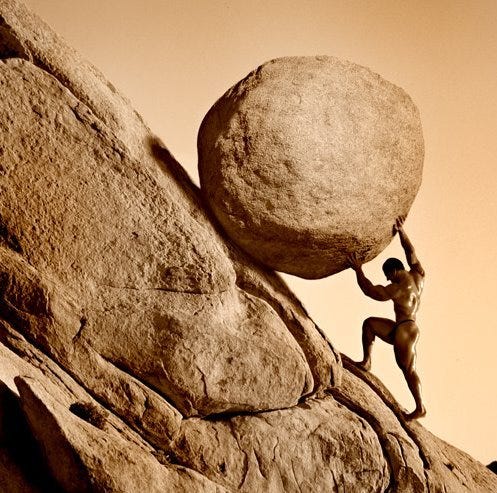
That fall, post-Earth ways, Patti had nine-day layovers in Europe. So, I was alone a lot. I avoided Chris and Kim because I didn’t want to talk about how my Earthways summer had gone. I was afraid they would say, “Told you so!” To heal my real and imagined psychic wounds, I spent quiet evenings alone, sipped Scotch in my comfy armchair, listened to folk and jazz — Dylan, Miles, Joanie Mitchel — and journaled about my Earthways “failure.” Whined might be more accurate. I leaned on my Valium in order to sleep.
I thought I had taken on too much too fast, stretched too far, and failed to live up to the idea I’d tried to instill in the kids. I hadn’t consistently applied the Action Sites tool to my thinking and acting. Or follow my personal “whys, ways, and hows” approach. I had acted more like a problem solver than a creator; getting by rather than making my vision a reality. To be fair, I had external and internal problems to solve. A new position! In charge of staff and kids 18-hours a day; on alert 24/7. Tipis blown over in the night. Bears ripping our food cache out of trees. The warden’s cabin rebellion. Too many kids who did not fully grok the learning and experiences I thought they should. Too much shoulding! As a result, I failed to manage the quality of my experience. I had less grit and gumption than I thought I’d had. Maybe I’d let my past catch up to me.
Junior and senior high school had sucked most of the gumption out of me. In high school and university, I had adopted the “just get by” philosophy — and set a low bar. The negative experiences I described in early chapters — probation officer, stuck in a high school classroom, struggling with administrative hypocrisy, punished for trying to be creative — did not help. Even in my CYC job, though I had amazing freedom, I’d sometimes felt like a failure. All examples of my “jump in, work hard, hit obstacles, quit…” pattern.
Not until Springbank’s dumb kids’ English, and Hector had I recognized opportunities to use my freedom to…. Co-leading LTS Camp with Kim restored my desire to stretch for the heights. ACC and Action Studies gave me templates. I had hoped inventing Earthways would be a suitable stretch goal — a mountain I could summit. But neither Earthways nor I had lived up to my expectations.
I moaned to myself, “I’m no free-lance Ronin camp creator.”
However, with time, distance, and judgment-softening whisky, I realized Earthways had been an experiment in freedom to…. Experiment and experience stem from the same Latin root, experiri “to try, test.” I had tried; I’d put myself and my vision to the test. Experimented, failed, recovered, tried again. But I had expected too much. So, I reminded myself that “experience is not what happens to me; it’s what I do with what happens.”
On closer reflection, I decided my vision was solid. My disappointment had stemmed from small failures and nagging “cudda, wudda, shudda” thinking. Slowly, I saw I had learned much from my summer. Ideas about how to do more with less crept into my mind. I wondered if I should — could? — try again. But fears of another breakdown skewed my thinking. So, I enjoyed my quiet nights. I helped Ken on the Can-Do and Realization programs, and, see-sawed between No Way! and Maybe? on Earthways.
In late February, I bumped into Chris Miller at a Hector staff party in Russ Nichols’ family’s basement rec room. He handed me the mickey of Bushmills Whiskey he kept tucked in his cowboy boot.
“Drink up,” he said. “Gary just told me I’m directing Wilderness 1 this summer!”
I sipped the Irish, then wiped my mouth.
“Congrats, Chris! You’ll make a —”
“So,” he said. “Slide shows!”
“Slide shows?” I handed his bottle back.
“For recruitment. I want Gary to buy dual Kodak projectors with a fade-dissolve controller. A SONY reel to reel and Bose speakers. We could make kickass 15-minute shows about our programs and show them to kids around the city.”
“I, uh —”
“You doin’ Earthways again?” I coughed; looked at the floor. “Your contacts could get us into high schools, eh? Be easier to get Gary to buy the gear if we both use it.”
Ah, Chris, always an angle.
I realized the stress and energy I had spent recruiting campers the previous spring had worn me down even before Camp started. I’d limped into the summer at half speed. High school slide shows in might make recruiting easier. For the next week, I pondered Chris’s suggestion.
I also wondered, “How I could change Camp cons into pros?”
Hire more staff? Simplify Chautauquas? Better connect inputs to challenges? Listen more? Find a more remote site? Get a tent for myself. No 14-year-olds!
Patti was okay with me doing another summer. Ken less so. He thought once should have been enough to learn the lessons I needed. I argued, “Instead of repeating my jump in, fail, quit pattern‚ I want to apply your ‘try, try again’ approach.”
“Hmm,” he said, pursing his lips. “I suppose it might be okay.”
In March, I called Chris. “Let’s make some slide shows.”
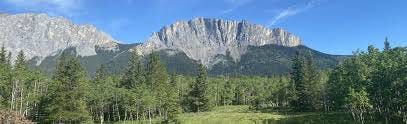
Our Base Camp meadow with Goat and Yam behind it
Both Chris’s and my programs filled by end of May. A GM dealer lent me a ‘72 Chevy pickup for the summer so we could truck fresh food and water from Yamnuska Centre during Base Camp.
I had decided that Cooking — at Base and on the trail — would be a new Can Do activity for our kids. We’d teach them to cook simple, nutritious meals on the stoves and over campfires. Staff would cook separately, so, if kids screwed up, we wouldn’t step in and rob them of a learn-from-experience opportunity. On hikes, we’d use NOLS (National Outdoor Leadership School) Cookbook recipes. Groups of four kids would cook simple meals from scratch. We’d label all ingredients, so kids wouldn’t rely on us to tell which was what.
I had waterproof, grommeted, nylon lean-to tarps made. I bought myself a red, 2-man mountain tent. Candle patterns so I could read or write in the tent. Then I rambled the semi-wild area below Yam and Goat Mountains, searching for a new site.
When I invited Dunc Dow to join me for the summer, the eyes of the 20-year-old ex-Hector counsellor who had liked my “salamander” rant lit up. “
“Yes! For sure! I’d love to.”
Fit, friendly, and handsome, Dunc favoured white t-shirts and tight Adidas shorts that showed off his hockey player/cross-country runner muscles. Abrupt bangs squared off collar-length black hair. The previous summer Dunc had counselled at Wilderness 1. So, he could lead our climbing program. He’d also learned Action Studies basics from his biology teacher, a Ken Low devotee, who had run an after-school program at Dunc’s high school.
When I asked Dunc if he knew any women counsellors he would recommend we hire, he said, “We should consider Barb Cook from my Action Studies group.”
“Counselling experience?”
“Not much at camp. The PIT last summer, I think. But she’s worked teen programs at the North Y for years.”
Strong-looking, with friendly blue eyes, blonde-haired Barb, 20, gave off a thoughtful, motherly air. The three of us agreed to hire 19-year-old Jan Andersen. Though she lacked group counselling experience, Jan had taken Hector groups on 3- to 5-day horse trips. Smaller than Barb, yet fitter looking, she kept long brown hair held back with matching barrettes. Her firm yet easy way with kids had impressed me.
Mid-June, the four of us hiked into our new Base Camp site below Goat. I’d flagged a faint trail through the forest. It led past marshes, a small, crescent-shaped lake, then up a damp ravine to a football-field-sized meadow surrounded by a spruce forest. Aspens dotted the edges of the field and ran across its centre. The team loved it. They also loved the new nylon lean-to tarps. We set them up, stashed our gear under them, then backtracked to the truck. We packed in two blue plastic, five-gallon water jugs. And two light-weight, black metal, Airtight wood-burning stoves.
For three days, we explored the area around our new Base, assessed potential ACC sites, practiced Action Skills, and got to know each other. One afternoon, Dunc and I tutored Barb and Jan in basic bouldering techniques. I introduced the “whys, ways, hows” approach. And helped the others see how that structure would work as the basis for each and all programs.
By accident, I displayed the Can-Do impact of our new “Cooking From Scratch” program. I had baked nothing; ever. But, one afternoon, when I pulled melt-in-your-mouth cinnamon buns from one of the stove’s ovens, I pumped my fist in the air and jumped up and down, hollering “I did it! I did it! I made Cinnie buns! I can do! I can do!”
The others fell down laughing, then inhaled the tasty treats.
When staff training ended, we spent two Saturdays at Yamnuska Centre. We sorted climbing and first aid gear, prepared personalized journals for the kids, and organized outtrip food. The NOLS cooking from scratch approach relied on basics such as rice, pasta, flour, powdered milk, porridge, and freeze-dried veggies, meat, and fruit. Weighing, measuring, bagging, and labelling 30 days of outtrip food was a challenge.
“Why label everything?” Barb asked. “Can’t we just tell the kids the difference between baking powder and baking soda?”
“We want cooking to be a Can-Do challenge,” I said. “That’s the Why. Once we teach campers the basics and provide them with ingredients, we won’t interfere with their strategies (Ways) or any specific processes (Hows). It’s a ‘teach a person a fish’ approach.”
Grudgingly, but grinning, Barb agreed.
July 5, we waited at the trailhead, shifting from foot to foot, laughing too loud, waiting to welcome sixteen 15- to 17-year-olds.
When they came off the bus, I welcomed them all and introduced the staff to them. Jan handed out wallet-sized cards printed with,
“Beginnings are always filled with doubts and difficulties. — The I Ching.”
Then, each camper briefly interviewed another, then introduced their partner to the group. Much easier and more fun to introduce another person than to stammer through your own introduction; something I’d never liked.
With the ice broken; Dunc led us up the trail to Base. He organized a mixed group of kids to set up teepees on the far side of the meadow, sheltered by the trees. Barb supervised another group who secured two heavy-duty, 12-foot tarps over the cooking area. Jan helped four girls erect an army-surplus wall tent to serve as library and craft space. I made sure each kid took a turn digging latrines and wandered around helping where needed. Most of us knew everyone’s name by supper.
In a break before dinner, I walked out to a boulder overlooking the little lake. Then, I took out my notebook, and went over my vision and plan for the next three weeks. I hoped I had learned enough, planned enough, and hired the right staff to make this summer better than the last. I hoped (prayed?) I would keep my emotions in check and avoid the cudda shuddas that had plagued me the previous summer. I reminded myself again that ‘experience’ was what I did with what happened. I hoped last summer’s lapses in judgments had improved my decision-making.
That evening, Dunc and I led a “What To Expect” Chautauqua, outlining our vision and approach. Jan and Barb explained Downtime. Then they handed out black, hardcover, 8-by-5-inch journals with inspirational quotes pasted every few pages, such as:
“Into the forest I go, to lose my mind and find my soul.” — John Muir.
“Those who contemplate the beauty of the earth find reserves of strength that will endure as long as life lasts.” — Rachel Carson
Before we retired to bed, all four of us agreed that we’d had a good first day. An excellent start.
On our second day, both groups rambled up Exshaw Creek together. We set up camp in a well-used campsite. That afternoon, we did simple ACC activities while exploring a side valley. After dinner, I sat under a scrawny spruce tree, smoked my pipe, and journaled:
This is so different from last year. Having a team makes everything easier. I don’t have to do it all! I can let things unfold, confident the program is solid, the staff able. Dunc is a godsend!
It rained during the night, but bright sun woke us and dried the site. After breakfast, and a question-and-answer session, Dunc introduced Creek Running. We ran up the creek bed, jumping from rock to rock, scampering across logs, easing along 3-inch ledges. Each kid found their own level. Fit, athletic kids ran up 100 yards, then ran back down to keep the group together. Less athletic kids picked their way up easier parts. Amanda walked in the creek.
“I can’t do this,” the shy, fuzzy-haired 15-year-old whined.
“You won’t know that unless you try.”
I asked why she’d come to Camp?
“To get stronger, to do stuff better, and learn about the environment.”
I explained how remembering those goals — whys — could excite and help her clarify her waysand hows. Creek running, I explained, could help her build balance, courage, and confidence. I walked beside her, showed her how to step on close-spaced rocks at the creek’s edge, and how to use Action Skills to manage fear. She wasn’t happy, but she tried harder and began to get it.
After lunch at the top of the creek, we did 20-minutes of downtime, then ran back down the. Everyone’s balance and ‘gription’ improved. Amanda jogged a little at the end.
Second day, we hiked up a long game trail to the ridge of Exshaw Mountain. At the top, I read a story about the indigenous people who had lived in the surrounding area, and the explorers that interrupted their way of life. Stupendous views. Strenuous day. Much friendly chatter at dinner and into the evening.
On our last day, we rambled back to Base, exploring the post-glacial forests, meadows, and small lakes between the mountain walls and the river. Jovial chat; kids getting to know each other better; excitement building.
Back at Base, once kids got past “swamp clothes,” they took to bog crawls and marsh wades like toddlers to puddles. We had added a “Canopy” element to the Forest Loop. Dunc rigged a pulley system with which we lifted kids into treetops, and explained that the forest canopy provided a unique habitat in the forest ecology.
Most kids dug the simplified Chautauquas. The weather cooperated and all the other base camp activities went off without a hitch. We ended Base with a “Viewing Party.”
On our last night in Base, we sat in silence on the meadow’s high spot, bundled in our warmest clothes. Sipping Japanese plum wine from thimble-sized paper cups, we scanned the eastern sky. As a giant yellow-orange ball floated up from behind Mount Yamnuska, the kids cheered. Good times!
Dunc did a successful job organizing and running our rock school sessions. Barb and Jan did great, especially for beginner-climbers. After two days at Rock School, the groups climbed long ridges on Heart Mountain and Loder Peak. The climbs gave kids the experience of “exposure” — space under their feet — without requiring roped techniques. But about 2/3 of the way up the ridges, curtains of wind-driven rain stopped us from reaching summits. Barb’s group and I huddled under emergency tarps, shared trail mix, corny jokes, and farts. In between laughs, I heard snippets of “three W’s” and “action sites.” Around the fire that night, everyone agreed that despite miserable conditions, we had done well. We’d embraced difficult conditions as challenges, and turned what could have been a miserable failure into a successful day.
For the backcountry hike, the van dropped both groups near Marble Canyon, in BC’s Kootenay National Park. But three feet of snow on the west side of the valley had closed our chosen trails. After studying topo maps, Dunc and Barb headed south to explore the Simpson River area. Jan and I headed up Hawk Creek, on the east, snowless side of the valley. I lost a day following a well-worn trail on the wrong side of the creek. The next day, we grunted five miles and 3000 vertical feet up to Ball Pass on the Great Divide. [Later, in a guidebook, I’d read, “Hawk Creek is a rough trail for skilled backpackers.”]
We ate lunch behind a thundering waterfall, which excited the kids’ and improved the quality of their experience. We snacked on well-deserved trail treats at the top, then glissaded and scrambled down to Shadow Lake.
In the Banff Park campground, drunk partiers harassed our girls. So, we moved our lean-tos around the lakeshore, outside the permitted camping area. Next morning, we woke to horse-mounted wardens threatening illegal camping fines. When I told them about the drunks, they gave us a pass.
“But we’ll watch for you at Egypt Lake!”
There, too, drunks with boomboxes drove us into the woods.
Difficult trail finding on the south side of Redearth Pass lengthened our fourth day and tried my patience. In the dusk, I almost walked by a Warden’s cabin and headed the wrong way again. Jan caught the error, then pulled everyone together to cook communal spaghetti on the cabin’s porch. I popped a Valium.
We woke weary. Two boys, rebuffed by girls they were sweet on the night before, had adopted “tough guy” postures, and refused to respond to Jan’s directions. While we ate hot cereal, I did an impromptu mini-Chautauqua, urging the group to “rise to adversity and create the best experience we can, with whatever we have.” That and strong, private words with the boys seemed to settle things.
Drizzle started as we climbed the steep trail to desolate but strangely dry Honeymoon Pass. After eating lunch on the boulder strewn pass, we crossed the Divide and dropped back into BC. The upper reaches of Verdant Creek lived up to its name.
In the wild, V-shaped valley, avalanche chutes slashed through thick stands of cedar and fir, leaving patches of berry bushes. My neck hair stiffened each time I stepped around 10-inch bear scat peppered with berry seeds. Grizzly! Jan told the kids to sing and bang pots. Everyone but the “tough guys” complied. When heavier rain started, I asked everyone to put on rain gear. Most donned rainproof pants and jackets. But not the tough guys. They smirked at each other, and at me. Lightning flashes and winds that knocked together 100-foot trees as if they were tipi poles signaled the oncoming storm.
When hard rain set in, I told the tough guys to get their rain gear on. They chuckled, then stared at me with pursed lips.
“Did you hear me?” I said, “Rain gear!”
They crossed their arms, lifted chins. Fiery anger blazed in my chest.
“Put your goddamn rain gear on. Now!”
“Yeh?” said the taller boy, smirking.
I stepped chest-to-chest with him, fists knotted, ears ringing.
“Do it right fucking now. Or I’ll kick your skinny ass down to the river.”
Then I charged down the trail without a backward glance.
When I’d burned off my anger, I stopped, tried to explain — grizzlies, storm, falling trees, safety! The kids stared at me as if I’d killed their family pet. We hiked to the highway in silence.
At Vermillion Crossing, I shucked my gear by the gift shop, then walked across the highway. By the swift-flowing river, I sat on the rocks and cried.
A good hike turned sour by jerks trying to impress girls. And my failure to keep my ‘shuddas’ in check.
Back at Base, we all enjoyed a staff-cooked feast of Cornish Game Hens with baked yams and Brussels Sprouts. Barb and Jan made blueberry cheesecake for dessert. During the last campfire session, I apologized again. At the final picnic, every kid — even the tough guys, now much subdued — said they had learned a lot during the three weeks and had a wonderful time. Despite, one girl joked, “Bruce’s occasional outbursts to keep us in line.”
After the kids left, the four of us drank cold Coors and did a staff debrief in Yam Centre’s Family Cabin. Then we drove to Banff to celebrate Dunc’s 21st birthday. Over fondue in the Grizzly House, Jan turned to me, whispered, “It wasn’t your fault out there. I felt the same way, but was afraid to say anything to those boys.”
Jan’s support helped keep me from sliding into another post-camp gumption trap.
After two restful days off, we met 13 new campers at the trailhead.
Everything fell into place that period — until the morning of the final rock climb. Debbie, a petite sixteen-year-old, said she felt ill. The fit athletic girl had bouldered well and aced the short routes. But she balked at the last climb. Said she felt sick. I suspected she was just scared of the 75+ foot route. I wanted her to get the full “I can do!” effect from completing it. So I climbed beside her, cheering. At the top, she sat on a three-foot rock, took deep breaths, and exhaled slowly.
“Thank you, Bruce,” she said. “Now I know for sure I hate climbing and I won’t ever have to do it again.”
Then she rappelled the route like the fit young jock she was.
Barb and I began our backcountry hike at Moraine Lake, east of Lake Louise. We hiked up the right-hand side of the Valley of the Ten Peaks, dwarfed by the rugged ridges and peaks of Mount Fay, Deltaform, Wenkchemna, and others. Greenery fell away as we gained elevation. Clouds slid in front of the sun. The air chilled. We camped above Eiffel Lake; normally a sparkling alpine jewel ringed by grey rockfall. But as the clouds thickened, I realized why early explores had named this area Desolation Valley.
We planned to start early the next morning and push over Wenkchemna Pass, one of the Rockies’ highest serviced trail. But we woke to thick, black-bottomed clouds hanging just above our teepees. Debbie said she felt sick again. Nerves?
So, we decided to day-hike to the toe of Wenkchemna Glacier. As we poked along the ice’s edge, the clouds dropped on us like collapsing tarps. Drizzle turned to snow. We retreated. Halfway back to the lean-tos, Barb staggered; grabbed a boulder.
Slurring, she said, “I’m s-s-soaked to my s-skin.”
I wrapped a foil emergency blanket around her, draped my rain jacket over it, then hustled her back to the lean-tos. Dime-sized snowflakes settled on wildflowers. An eerie stillness enveloped us. Barb had stopped shivering — a sign of serious hypothermia. Girls wrapped her in sleeping bags. Boys started a fire and boiled water. My heart raced; my mind spun.
What to do? What to do? What…?
I walked off a way, then trod an erratic circle in the snow, trying to slow my spinning thoughts. I trembled. Felt faint. Could see only two options.
Run to Moraine Lake Lodge, call for a helicopter? NO! Can’t leave the kids on their own.
Send two strong campers out to call? NO! Too risky for them. Irresponsible of me.
Steel belts tightened around my chest. The Terror threatened to engulf me. I was near tears. Then, like a flash of sunlight piercing the clouds, it hit me.
Helicopters cannot fly in this weather. No one is coming to help. It’s all up to me!
A surprising calm settled over me. My breathing slowed. I dug my Mountaineering First Aid Guide out of my pack, then read the “Effects of Excessive Cold” section. Back at the lean-tos, I had the kids do everything the book said to treat hypothermia. Two girls stripped Barb and themselves. They the crawled into zipped-together sleeping bags with her. Others slid sweater-wrapped hot rocks into the bags at the girl’s feet. Two boys kept the fire stoked, and hot drinks coming. Two others cooked calorie-laden, margarine-thickened pasta soup. Girls took turns feeding Barb and tapping her face to keep her awake. After an hour, she started shivering again.
But before I could let out a relaxing “whew!” a second girl zombied up to the fire.
“My arms are dangling,” Risa said, a faraway look on her face.
We repeated the drill with her while still trying to warm Barb.
By dusk, snow hid everything but the fire. Everyone crawled into their bags. I set my watch timer for 60 minutes. Dozed. Woke. Swept snow off sagging lean-tos. Checked that designated kids had kept their patients awake and warm. Rotated in new kids. Repeated it every hour until 3 am. When both girls could speak clearly, I let my fear fall away. We all slept.
At first light, we punched the tarps upward to shed thick snow. Got up, packed, built a fire, gulped hot Tang and margarine-laced porridge. Then trudged and slid through 10 inches of drifted snow down to Moraine Lake Lodge. While kids sipped hot chocolate, provided gratis by the Lodge, I called Gary for pickup.
At Bowfort, the nurse checked Barb and Risa. All good. Debbie felt fine. We took hot showers, then dug into kitchen-prepared chicken and dumpling chowder with fresh-baked Parker House rolls — and butter! We debriefed our terrifying experience in a duplex, spent the night there, then returned to Base.
Barb apologized for not wearing proper rain gear.
“Someone at Hector told us two water resistant layers worked better than one waterproof layer. I should have listened to you.”
The final night’s debrief went smoothly. Dunc and Barb shared that they had mostly hiked and suntanned on long open ridges near the Simpson River. A friendly argument broke out between their kids and ours over who had had the highest quality experience. It led to laughter and hugs. At the picnic, the kids all praised the program and us. Said they wanted more.
In the fall, we would learn Debbie had not been ill. Or scared. She was pregnant.